#tdc5239 #ds106 #dailycreate What’s the last book you read? Share it with us, as a photo, or as a review
Apparently people don’t read enough nowadays. But that’s not true of we DS106ers is it? What’s the latest book you’ve read, or are reading? Share it with us, in a way that tempts others to dive in and read it as well.
The most recent book I read was for a bookclub and it was “The House in the Cerulean Sea” by TJ Klune. It is a heartwarming, charming, and upbeat book that transports you back to childhood. I will say that going into this book, I thought it would incorporate more adult themes as it is classified as fantasy and not young adult. However, it felt more like a kids book with the story closely following an adult. This book delivers themes of friendship, chosen family, free will, bravery, and oppression in a light-hearted manner. I was also surprised that it did offer me perspective on life and the importance of straying away from a routine and trying something new. After reading this book, I am more inclined to come up for air once and while and try something different. You never know, good things might follow. So, if you are looking for an easy and happy read, this one is for you!
Reflection
This was my first ever “daily create”! I chose to start with this one because it was something I was excited to do. I love reading so I have familiarity with creating reviews. Although, I usually say it out loud in conversation rather than writing it out. After reading the prompt, my mind instantly went to the last book I had read for a bookclub. It seemed like a perfect fit as I had already given a review (basically) verbally.
However, when I went to write a review, I was struggling to have my words capture what I meant. I instinctively added a photo I pulled from Pinterest to show the audience the aesthetic of the book, but then I thought “hang on,” that would defeat the purpose of this week’s challenge of using only text as my form of media. After learning the dual-coding theory which states that images and texts use different parts of the brain and that we can absorb more content using both forms, it made more sense to use this image. Just with a glance, the image could do what I was struggling to put into sentences. But, since this wasn’t the assignment, I focused on storytelling techniques and attempted to use descriptive language that conjured the same feeling. Upon reflection, I seemed to partially follow Merrill’s Principles of Instruction. Motivation came less from solving a real-world problem and more from having existing knowledge. This knowledge then became the foundation of my learning. From there, Demonstration followed naturally and I used Google to look at examples of book reviews as the prompt was vague. The application phase had me actually creating my own book review. In terms of Integration, I can genuinely see myself bringing what I learned about translating spoken thoughts into written language back to my bookclub.
#tdc5034 #ds106 #WriteOut Oh, The Os
The Ooparts generator turns the letter “O” into different designs. Find a good word with lots of Os and see what happens.
Reflection
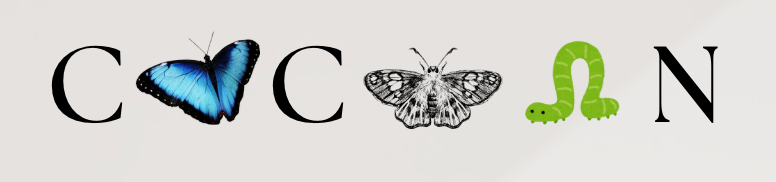
For my second “daily create”, I took inspiration from another student in the class and used Canva instead of the Ooparts generator. After trying the generator, I thought the prompt could be elevated and I wanted a bit more creative freedom. I chose cocoon as the word and the images I used were intentional. Instead of using random shapes for the Os (like the Ooparts generator), I replaced them with a butterfly, a moth, and a caterpillar, which are creatures people naturally associate with cocoons. My thought process was that this would be a good learning tool to study for tests. As we learned in class, if the images are connected to the word, the image and the text work together rather than competing for attention. In contrast, unrelated shapes (like seen in the Ooparts generator!) would have added extraneous cognitive load. Unfortunately, the whole “daily create” took about two minutes which made me pause and reflect. I felt that I had not learned anything because I finished the prompt so quickly, however, even though I was not learning a new skill, I still was deepening my muscle memory by using Canva. That said, this task didn’t push me very far. I already knew how to use Canva, so the process skipped straight to Application without much Demonstration. I also recognized that I need some challenges to grow. When a task only uses my existing skill set, the germane cognitive load (the productive mental effort that actually builds new knowledge) stays low. That’s a useful thing to know about myself as a learner!
#tdc5187 #ds106 #dailycreate Realms of Mythological Creatures
Wesley Fryer recently shared a Mythological Creature Selector project that he vibe coded for a school project with students.
Why not give the two wheels a spin — Realm of Unusual Beasts and Realm of Myth & Legend — and see what kind of story or art you can create with the results.
After 100 million years, what we once knew as an anteater is now a Voomba. This peculiar creature is a hybrid mammal that resembles an insect-sized anteater with butterfly wings. These beautiful creatures seemed to have evolved after ants and termites went extinct and anteaters had to rely on a different food source. Voombas have elongated snouts that allow them to lap up nectar. However, they attract a lot of attention with their butterfly wings so evolution demanded that they keep their sharp claws to attack predators. Voombas will live to survive another 2 million years before they all perish from starvation after flowers go extinct.
Reflection
Wow! This was my most challenging “daily create” of the week. But…maybe the most revealing? I chose this prompt because creative writing is something I haven’t done since high school. When I spun the wheel and it landed on the anteater and butterfly, I felt the urge to respin because I didn’t think I could come up with a story on an animal I don’t know much about. I held myself back to prevent undermining the exercise of working creatively within constraints I didn’t choose. The creation of this story was much slower and messier than I expected. I started by jotting down ideas, focusing on “what could this creature do?” and “what does it look like?”. I also turned to Google to look up anteater facts and images, essentially looking for anything that might give me inspiration. Upon reflection, I was applying Mayer’s principle of pretraining by building a foundation of knowledge of the anteater before trying to create a story using this animal. The writing itself took about 1 hour, which was humbling since I only wrote 100 words. In hindsight, my intrinsic cognitive load was high and I could have used segmenting to help.
Recent Comments